
IntelePACS vs Medicai: Workflow Orchestration Compared
You are comparing two PACS platforms and need to know which one actually coordinates your radiology workflow, not just stores images. The wrong pick shows up later as manual routing, scattered CDs, and radiologists chasing studies across sites. This comparison gives you a direct answer.
You will see how IntelePACS handles on-premise routing versus Medicai's cloud-native orchestration, how each supports image sharing across locations, and where AI fits into the workflow. You will also get a pricing breakdown and a clear verdict on which platform fits your organization.
Quick Verdict: IntelePACS vs Medicai for Workflow Orchestration
For radiology groups prioritizing rapid deployment, multi-site coordination, and predictable subscription costs, Medicai's cloud-native workflow orchestration offers a compelling alternative to IntelePACS's on-premise routing engine. Both platforms address the core needs of a picture archiving and communication system, but they approach the problem from different directions.
IntelePACS is a long-established PACS with deep roots in hospital radiology departments. It is generally associated with on-premise infrastructure and extensive configuration options, which suits organizations that want tight control over their imaging environment. Medicai, by contrast, runs as a cloud-based platform with a zero-footprint DICOM viewer and automated workflows built around remote access.
The practical difference shows up in how each platform handles study routing, worklist management, and reading workflow across sites. Medicai's cloud model supports multi-site coordination without local server build-outs, while IntelePACS's routing engine is designed for complex on-premise environments where customization matters more than speed of rollout.
Here is the short version of how the two compare on the dimensions that matter most for workflow orchestration.
- Deployment and scalability: Medicai is cloud-based, so adding sites or users does not require new on-premise hardware. IntelePACS typically depends on local infrastructure, which can mean longer setup cycles.
- Remote and multi-site access: Medicai's zero-footprint viewer supports distributed reading and coordination across locations. IntelePACS is strongest inside a well-resourced on-premise environment.
- Integration ecosystem: Medicai processes over 50M+ yearly API transactions and supports DICOM, HL7, and FHIR-based integration, with a Microsoft Azure partnership behind the platform. IntelePACS offers established enterprise imaging connectivity, generally configured on site.
- Customization versus speed: IntelePACS excels in complex on-premise environments with deep customization. Medicai favors faster deployment and predictable subscription costs.
On the Medicai side, the platform reports 1M+ studies transacted or processed per year, 70 clinics and hospitals, and 10,000+ active doctors. It is HIPAA and GDPR compliant, with FDA/CEE cleared viewers available. These are the kinds of operational signals that matter when a group is weighing a move to a cloud PACS.
The trade-off is straightforward. Teams that need heavy, site-specific customization and already run mature on-premise infrastructure may find IntelePACS a natural fit. Teams that value quick rollout, remote reading, and a managed cloud environment will likely see Medicai as the more practical path for workflow orchestration.
At a glance: how Medicai compares to IntelePACS on the features that matter most.
| Feature | Medicai | IntelePACS |
|---|---|---|
| Workflow Orchestration | ✓ | ✓ |
What Is Medicai?
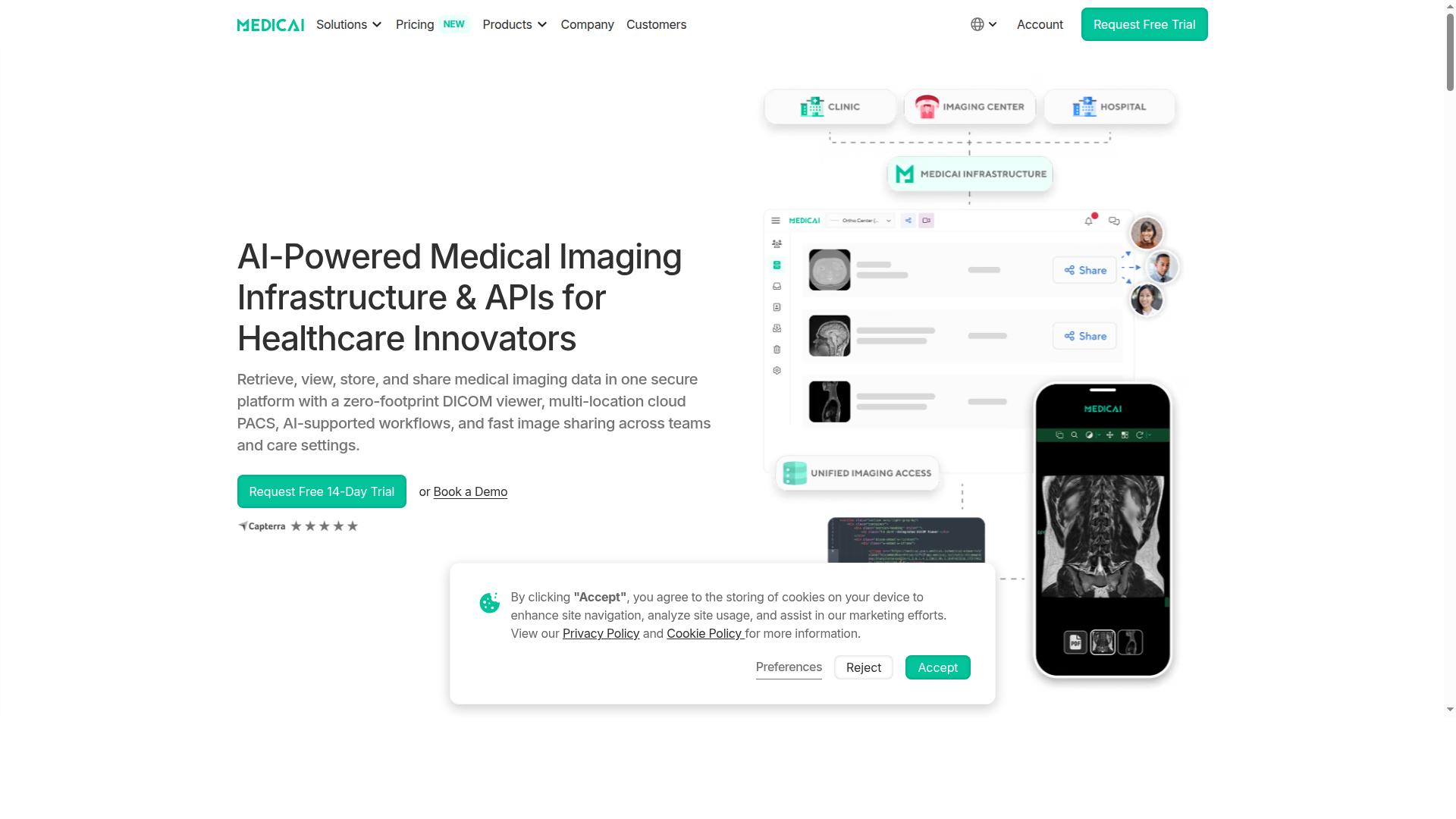
Medicai is a cloud-based medical imaging platform that enables healthcare providers to retrieve, view, store, and share medical imaging data in one secure environment with a zero-footprint DICOM viewer. It is built around Imaging Infrastructure as a Service (IIaaS), a delivery model that moves the picture archiving and communication system out of the server room and into the cloud.
The platform targets hospitals, imaging centers, and specialty care providers that need to connect imaging across multiple sites. Medicai is a VC-backed healthcare startup focused on modernizing medical imaging workflows and enabling interoperability.
Its core offering combines three capabilities that matter for workflow orchestration:
- Cloud PACS with multi-location support, so studies from different facilities sit in one accessible archive.
- Medical image exchange for fast sharing across teams and care settings.
- AI-supported workflows and a zero-footprint DICOM viewer that runs without local installation.
For radiology workflow, these pieces support tasks like study routing, prefetching, and hanging protocols without the overhead of maintaining on-premise PACS hardware. The cloud model also simplifies how DICOM data moves between sites and how teams pick up work from a shared queue.
On compliance and access, Medicai is designed for healthcare environments with HIPAA and GDPR alignment, and the viewer carries FDA and CEE clearance. That combination matters for providers comparing cloud PACS against traditional on-premise PACS deployments, where compliance and viewer certification are often the deciding factors.
The takeaway is straightforward. Medicai positions itself as a modern, interoperable imaging layer for organizations that want orchestration and exchange in one place, rather than a patchwork of local archives and standalone viewers.
What Is IntelePACS?

IntelePACS is a widely used on-premise picture archiving and communication system (PACS) known for its robust workflow orchestration and deep integration with enterprise imaging environments. It is built by Intelerad and has long been a common choice for imaging operations that need tight control over how studies move from scanner to radiologist.
At its core, the platform handles the classic PACS responsibilities: storing images, managing the modality worklist (MWL), and presenting studies through configurable hanging protocols. On top of that foundation, it adds a workflow layer that lets administrators decide where studies land, who reads them, and in what order.
That workflow layer is what most enterprise imaging teams care about. It typically includes:
- Study routing and auto-routing rules that direct exams to specific reading sites or subspecialty groups
- Worklist management with filtering, prioritization, and assignment logic
- Hanging protocols tuned to modality, body part, and reader preference
- Prefetching of prior studies so comparisons are ready at read time
- Integration with HL7, DICOM, and IHE-based systems through an integration engine
These capabilities are generally described in vendor materials as highly configurable. In practice, that flexibility is both the strength and the cost: the more rules an organization layers in, the more deliberate the setup and maintenance becomes.
IntelePACS is most often deployed in large hospitals and imaging networks with complex IT infrastructures. Those environments usually have multiple modalities, several reading locations, and existing enterprise systems that all need to talk to one another. An on-premise PACS fits that picture because it sits inside the organization's own data center and connects directly to internal infrastructure.
That deployment model has trade-offs worth naming. On-premise systems can offer strong local control and predictable performance on a managed network, but they also require dedicated servers, storage, and IT staff to run and upgrade them. Scaling typically means adding hardware rather than adjusting a subscription.
For readers evaluating workflow orchestration, the key point is that IntelePACS is a mature, feature-rich on-premise option. Whether it is the right fit depends on how much infrastructure an organization is prepared to own, a question that becomes central when comparing it with cloud-based alternatives like Medicai later in this article.
Features Compared
This section compares Medicai and IntelePACS across three critical areas: workflow orchestration, image sharing and collaboration, and AI-supported workflows and integration. Both platforms offer capable feature sets for radiology departments and imaging groups, but they differ in how they are built and how openly they connect to the surrounding ecosystem.
The core distinction is architectural. Medicai is a cloud PACS delivered as SaaS, while IntelePACS is typically deployed as an on-premise PACS with a long enterprise track record. That difference shapes deployment speed, IT overhead, remote access, and how easily third-party tools plug in.
Each subsection below looks at what the features do, who they suit, and where the practical trade-offs sit. The comparisons focus on publicly available information, documented capabilities, and general architecture, not hands-on testing.
Workflow Orchestration: Cloud-Native Automation vs On-Premise Routing
Medicai's cloud-native workflow orchestration supports study routing, prefetching, and worklist management, while IntelePACS relies on on-premise routing engines that require manual configuration and maintenance. The result is a different balance between control and day-to-day effort.
Medicai's orchestration layer is built around AI-supported workflows and a notification engine that keeps the right people informed. Rules can express priorities such as STAT prioritization, so urgent studies surface first in the reading workflow. Subspecialty routing sends cases to the appropriate readers, and load balancing spreads workload across the team to support radiologist productivity.
Because the rules live in the cloud, deployment is fast and remote management is straightforward. A new site, a new rule, or a shift in staffing can be reflected in the workflow without standing up local servers. That matters for teleradiology and multi-site groups where reading capacity moves between locations.
IntelePACS offers deep customization of routing and worklist management, and mature on-premise installations can be tuned precisely to local conventions. The trade-off is that this depth often comes with IT overhead: configuration changes, maintenance windows, and infrastructure that must be managed on site. For organizations with a strong IT team and stable, single-site operations, that model can work well. For groups prioritizing rapid deployment and remote flexibility, Medicai's cloud approach reduces friction.
Image Sharing, Collaboration, and Multi-Location Coordination
Medicai enables secure image sharing and collaboration across locations via its cloud-based medical image exchange, while IntelePACS typically requires VPNs or dedicated infrastructure for multi-site coordination. That difference becomes visible the moment studies need to move beyond a single building.
Medicai's Medical Image Exchange and zero-footprint DICOM Viewer let clinicians open studies from a browser without local software. Patient Case Management keeps relevant images and context together for a case, and the Vendor Neutral Archive provides a standards-based store that is not tied to one viewing system. Together these support tumor boards, second opinions, and cross-site consultation.
Multi-location coordination is a natural fit for this model. The Doctor Imaging Portal and Patient Imaging Portal extend access to referring physicians and patients, and the Mobile Imaging App supports review away from a workstation. YTS-Dental View, for example, integrated 10 locations across Romania and reported 90% less time to access patient studies.
IntelePACS supports sharing through on-premise methods that may involve complex networking and dedicated links between sites. These arrangements can be secure and well established, but they tend to demand planning and infrastructure for each new location. For organizations that expect to add sites, partners, or remote readers, Medicai's cloud exchange lowers the coordination burden.
AI-Supported Workflows and Integration Ecosystem
Medicai integrates with AI partners like MD.ai, Rayscape.ai, and MedDream through its open API and DICOM/HL7/FHIR standards, whereas IntelePACS offers AI integration primarily through on-premise modules and vendor-specific interfaces. The contrast is between an open, API-driven ecosystem and a more closed, appliance-style approach.
Medicai's integration surface is broad and standards-based. The platform supports DICOM, HL7, FHIR, and IHE, and the Medicai Imaging API lets third parties build on top of the archive. Named partners include MD.ai, Tquila Automation, FlexView, OHIF, MedDream, Rayscape.ai, and Meditice, alongside infrastructure providers such as Microsoft Azure, Amazon AWS, and Hetzner.
This ecosystem supports AI-Powered Diagnostics, the Radiology AI Co-Pilot, and automation that connects imaging to broader clinical systems. Because the platform is cloud-hosted, new integrations can be rolled out without local hardware, which shortens the path from evaluation to production for AI tools.
IntelePACS has AI capabilities and integrations, generally delivered through on-premise modules and vendor-specific connections. These can be effective within an established enterprise imaging estate, but adding a new AI tool may involve local deployment and vendor coordination. For teams that want to trial and adopt AI quickly across sites, Medicai's API-driven, cloud-first model offers a faster route.
Pricing Compared
Medicai offers transparent monthly subscription plans starting at $249/month for 500 GB storage, while IntelePACS typically involves upfront licensing and infrastructure costs that are quoted per project. That difference in how pricing is presented shapes how each platform fits into a radiology department's budget.
For workflow orchestration planning, cost predictability matters as much as feature depth. A cloud PACS with published tiers lets teams forecast spend before a single study is routed.
| Plan | Price | Cloud Storage | User Accounts | Connected Locations |
|---|---|---|---|---|
| Starter | $249/month | 500 GB | Unlimited | None |
| Standard | $749/month | 2 TB | Unlimited | One connected location |
| Enterprise | Custom pricing | Custom | Unlimited | Multiple connected and external locations |
Each tier includes unlimited user accounts, so adding radiologists or referring clinicians does not trigger per-seat charges. Yearly billing saves 15%, bringing Starter to $209/month and Standard to $639/month when paid yearly. A DICOM Gateway Setup costs $1,000 one-time per location, and a free 14-day trial of Starter plan features is available with no credit card required. Per-study pricing is offered for enterprise customers.
IntelePACS pricing is not publicly listed. Based on publicly available information, deployments of this kind generally combine license fees, hardware, and ongoing maintenance contracts, with quotes assembled per project. That structure can suit large hospital systems with established capital budgets, but it makes early cost comparison harder for smaller teams.
Total cost of ownership diverges along the same lines. Medicai's model is predictable operating expense: a fixed subscription plus a one-time gateway setup. On-premise PACS deployments typically carry capital expenditure for servers and storage, plus IT overhead for patching, uptime, and refresh cycles. For a department weighing workflow orchestration upgrades, the subscription approach keeps budget discussions focused on clinical value rather than infrastructure line items.
Who Should Choose Medicai
Medicai is ideal for imaging centers, specialty practices, and multi-site healthcare organizations seeking a scalable, cloud-based PACS with low upfront costs and rapid deployment. Where IntelePACS tends to suit large hospital enterprises with established on-premise infrastructure, Medicai fits teams that want workflow orchestration without the weight of a traditional picture archiving and communication system rollout.
The platform is built for healthcare providers including hospitals, imaging centers, and specialty care providers. It also serves virtual care providers, telemedicine platforms, and teleradiology services, which makes it a natural fit for distributed reading models.
Below are the profiles that gain the most from choosing Medicai over a legacy enterprise PACS.
- Small to mid-sized imaging centers that need diagnostic reading, worklist management, and study routing without a heavy capital project.
- Orthopedic and neurology practices that read their own imaging and want a cloud PACS tied to their clinical workflow.
- Telehealth and virtual care providers, including telemedicine platforms and teleradiology services, that need remote reading and collaboration across locations.
- Multi-site healthcare organizations that want consistent workflow orchestration across facilities without per-location constraints on the Starter plan.
- Research and education groups, including tumor boards, clinical trials, and medical education organizations, that need shared access to imaging.
Two commercial details matter most for growing teams. Medicai includes unlimited user accounts, so adding radiologists, referring clinicians, or collaborators does not trigger per-seat cost creep. The Starter plan also carries no connected location limits, which suits organizations that open new sites or read across several facilities.
Global availability is another practical advantage. A cloud PACS lets distributed teams access studies and collaborate from wherever they work, which is harder to achieve with an on-premise PACS anchored to a single data center.
Compliance and integration round out the case. Medicai supports standards-based interoperability, including DICOM, HL7, and FHIR, so it can connect to existing systems rather than replace them. Ease of integration matters for workflow orchestration, because modality worklist, study routing, and prefetching all depend on clean data exchange between the PACS and surrounding systems.
Medicai also extends beyond the radiology department. It serves personal injury lawyers and patients through a Patient Portal, which means the same platform can support collaboration and image sharing outside the reading room.
The trade-off is straightforward. Organizations with deeply customized on-premise enterprise imaging estates and heavy internal IT investment may still weigh a legacy system. For most small to mid-sized centers and specialty practices, though, Medicai offers a faster path to cloud-based workflow orchestration at a lower upfront cost.
Who Should Choose IntelePACS
IntelePACS is best suited for large hospitals and enterprise imaging networks that require deep on-premise customization, existing IT infrastructure, and strict data sovereignty. These organizations typically treat their PACS as a long-term platform, not a plug-in service, and they have the staff to run it that way.
In practice, the IntelePACS profile looks fairly consistent. The table below summarizes the traits that tend to align with it.
| Signal | Points Toward IntelePACS | Points Toward a Cloud PACS |
|---|---|---|
| Organization size | Large health systems, academic medical centers, multi-site networks | Mid-size and growing practices, distributed teams |
| IT capacity | Dedicated imaging informatics and infrastructure staff | Lean IT team or limited server footprint |
| Customization needs | Heavily tailored routing, hanging protocols, and integrations | Standardized, configurable workflows |
| Data governance | Strict data sovereignty and local control requirements | Cloud hosting acceptable under policy |
| Change cadence | Slow, deliberate upgrade cycles | Frequent, low-friction updates |
Large health systems and academic medical centers are the classic IntelePACS audience. They often run complex study routing across many facilities, maintain long-standing HL7 and DICOM integrations, and rely on an integration engine their own team controls. When workflow orchestration must bend to institutional rules rather than the other way around, an on-premise PACS with deep configuration options tends to fit.
Organizations with strict data sovereignty obligations also lean this way. Keeping images and patient data inside their own data centers can simplify compliance reviews, even if it shifts more operational burden onto internal staff.
There are trade-offs to weigh honestly. On-premise control generally means the organization owns hardware refresh, patching, and capacity planning. Scaling for a new site or a surge in imaging volume may take procurement and planning cycles rather than a configuration change.
Teams without dedicated imaging IT staff often find that burden heavy. If the priority is faster deployment and less infrastructure management, a cloud PACS model usually fits better, and that is where Medicai is designed to sit.
For this article's target reader, the practical test is simple. If your workflow orchestration depends on bespoke routing, local data control, and an in-house team to run it all, IntelePACS is a reasonable fit. If you want the same routing, worklist management, and STAT prioritization discipline without owning the infrastructure, a cloud platform is the stronger choice.
Final Verdict
For most radiology practices prioritizing agility, predictable costs, and modern workflow orchestration, Medicai's cloud-native platform delivers a stronger value proposition than IntelePACS's traditional on-premise model.
The two platforms solve the same core problem, moving studies and information through the radiology workflow efficiently, but they start from opposite directions. IntelePACS brings depth in on-premise customization. Medicai brings a cloud-first architecture built around open integration and transparent access.
| Differentiator | Medicai | IntelePACS |
|---|---|---|
| Deployment model | Cloud PACS with Microsoft Azure partnership | On-premise PACS with deep local customization |
| Scalability | Cloud scalability, 1M+ studies processed per year and 1.7M+ studies in storage | Scales through local infrastructure investment |
| Integration | Open integration with 50M+ yearly API transactions | Established integration engine, typically configured on site |
| Pricing | Transparent SaaS pricing | Generally structured around on-premise deployment |
| Compliance | HIPAA and GDPR compliant, OWASP security guidelines followed | Compliance handled through local infrastructure controls |
| Viewer | FDA/CEE Cleared Viewers available | Vendor-provided diagnostic viewer |
Medicai's verified footprint shows the platform operating at real scale. It supports 70 clinics and hospitals and more than 10,000 active doctors, with 2M+ imaging studies uploaded and 300k+ DICOM study visualizations in the last year. The platform also reports reducing diagnosis time by 65%, a meaningful figure for teams watching turnaround time.
IntelePACS remains a credible choice for organizations with heavy on-premise investment and a need for deep local customization. That depth comes with infrastructure ownership and the operational overhead that follows it.
Choose based on what your organization needs most:
- Medicai fits practices that want cloud scalability, transparent pricing, open integration, and fast deployment across distributed teams.
- IntelePACS fits organizations with existing on-premise infrastructure and a strong internal IT team supporting deep customization.
- Mixed or growing networks often benefit from cloud-native workflow orchestration that scales without new hardware.
For teams ready to compare platforms against their own radiology workflow, Medicai offers a direct path to a demo or consultation. Contact the Medicai team to discuss your study volumes, integration needs, and compliance requirements.
Frequently Asked Questions
What is the core difference between IntelePACS and Medicai?
IntelePACS is a distributed radiology platform focused on storing, retrieving, and routing medical images within radiology workflows. Medicai is a cloud-based medical imaging platform that combines retrieval, viewing, storage, and sharing in one secure environment, with a zero-footprint DICOM viewer and multi-location cloud access. In short, IntelePACS centers on radiology image management, while Medicai is built around end-to-end imaging workflow orchestration across locations and teams.
How does Medicai support multi-location imaging workflows?
Medicai is designed for multi-location cloud operations, letting healthcare providers retrieve, view, store, and share imaging data from a single secure platform. Its Standard plan includes one connected location, while the Enterprise plan is customized for organizations with broader needs. This makes it straightforward to extend imaging access across sites without deploying local infrastructure.
Can we connect our existing imaging sources to Medicai?
Yes. Medicai provides a Medical Imaging Uploader and a DICOM Gateway for connecting and retrieving imaging data, so facilities can bring existing studies into the platform. Once connected, images can be stored, managed, and shared through the cloud PACS, medical image exchange, and vendor neutral archive capabilities. This allows teams to keep their current sources while gaining centralized cloud access.
How does Medicai's pricing compare with IntelePACS?
Medicai publishes transparent monthly plans: Starter at $249/month with 500 GB cloud storage and unlimited user accounts, and Standard at $749/month with 2 TB storage and one connected location, plus custom Enterprise pricing. IntelePACS does not state pricing publicly in the sources reviewed, so a direct cost comparison isn't possible without requesting a quote from them. We recommend evaluating both against your storage volume, number of locations, and user count.
Does Medicai offer a zero-footprint viewer and compliance coverage?
Yes. Medicai includes a zero-footprint DICOM viewer, so users can visualize and collaborate on studies through a browser without installing software. The platform is HIPAA and GDPR compliant, and FDA/CEE cleared viewers are available. These features support secure access for distributed clinical teams and virtual care scenarios.
Which organizations is Medicai best suited for?
Medicai serves healthcare providers including hospitals, imaging centers, specialty care providers such as orthopedics, neurology, oncology, radiology, cardiology, and ophthalmology, as well as virtual care organizations. It is available worldwide online and scales from a single site on the Starter plan to customized Enterprise deployments. IntelePACS, by contrast, is positioned as a distributed radiology platform, so the right fit depends on whether your priority is radiology-centric routing or broader multi-location imaging orchestration.