
Is Autoblogging.ai Good for Multi-Model Support?
Picking an AI writing tool usually means picking one model's voice for every post. Some platforms lock you into a single engine, so news briefs, product reviews, and bulk drafts all come out sounding the same. That matters when you publish across niches.
This article answers whether Autoblogging.ai handles multi-model support well. You will learn what each mode does, how Quick, Godlike, Bulk, News, and Amazon Reviews differ, what the plans cost, and who gets the most out of it.
What Is Autoblogging.ai?
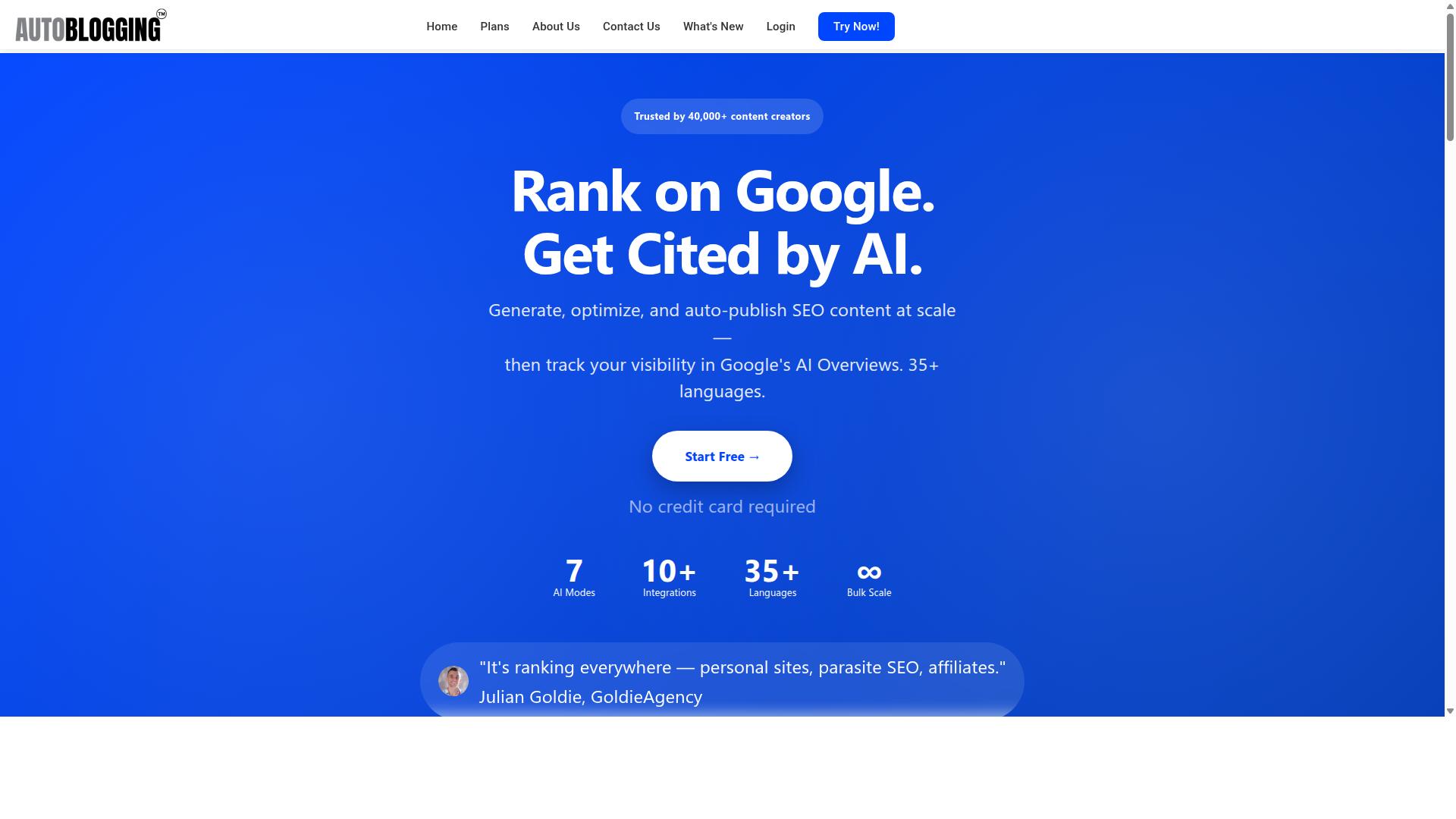
Autoblogging.ai is an AI-powered content generation platform that automates article creation for bloggers, marketers, and agencies. It is a product of Digimetriq.com, built with a clear mission: help bloggers, website owners, and agencies save time and improve their online presence through cutting-edge technology.
Founded in 2022, the platform has since generated over 1 million articles. Its stated aim is to cut down content costs and enable human teams within their standard operating procedures by delivering a strong first draft.
Because automated blogging depends on the quality of the underlying large language models, multi-model support sits at the heart of how a tool like this performs. That context matters before examining how well Autoblogging.ai handles model integration, model switching, and output quality.
Who It Serves and What It Does
Autoblogging.ai caters to a diverse range of users, including bloggers, website owners, SEO professionals, marketing agencies, and affiliate marketers. Each group has a different reason for adopting AI content generation, and the platform is positioned to address those differences.
Bloggers need consistent output to keep a publishing schedule alive. Affiliate marketers need to scale niche sites without scaling costs. Agencies juggle content demands across multiple clients at once. For all three, the value of multi-model support is flexibility: the ability to match a task to the model best suited for it.
The platform serves a wide spread of site types:
- Personal sites
- Parasite SEO
- Affiliate sites
- Client websites
- Portfolio sites
- Local sites
That breadth explains why model compatibility matters so much. A local site may need short, location-focused posts, while an affiliate site may need long-form SEO content at volume. Features like multi-model support and bulk generation let users approach those jobs differently rather than forcing one model, one prompt, and one output style across every project.
For agencies in particular, this range of supported site types means one platform can cover very different client briefs. Rather than maintaining separate tools for each content format, teams can lean on content automation to handle the repetitive first-draft work and reserve human effort for editing and strategy. The result is a workflow where AI writing tools do the heavy lifting on volume, and people focus on quality control and direction.
Is Autoblogging.ai Good for Multi-Model Support? The Direct Answer
Yes, Autoblogging.ai supports multi-model content generation. This is not a side feature bolted on after launch. It sits at the core of how the platform approaches AI content generation.
Rather than locking users into a single engine, Autoblogging.ai connects through API connectivity to providers like OpenAI, Anthropic, and Google AI. That means users can move between models without rebuilding their workflow or learning a new interface.
For anyone producing SEO content at scale, that flexibility matters. Different models bring different strengths in natural language processing, tone, and structure. A tool that supports several of them gives you options instead of limits.
Here is why this multi-model approach stands out:
- Improved output quality: you can match the model to the task, whether that calls for sharp reasoning or fluid, conversational prose.
- Content diversity: rotating between engines helps avoid the repetitive phrasing that creeps into single-model pipelines.
- Performance optimization: when one model is slow or rate-limited, another can keep the work moving.
- Future-proofing: as new large language models arrive, a multi-model setup is positioned to adopt them faster.
The practical benefit is simple. A blogger writing a technical explainer might lean on one model for accuracy and another for a friendlier rewrite. A marketer running dozens of posts a week can spread the load across providers to smooth out latency and throughput.
It is also worth noting what this is not. Multi-model support does not mean juggling separate subscriptions or copying prompts between browser tabs. The switching happens inside the platform, which keeps content automation intact from outline to publish.
Compared with single-model AI writing tools, the difference comes down to range. One engine means one voice and one set of quirks. Several engines mean you can compare, adjust, and pick what fits each project.
So the verdict is clear. For multi-model support, Autoblogging.ai is a strong choice, and that capability is a defining strength rather than an afterthought. Buyers evaluating any AI writing tool should treat broad model compatibility as a deciding factor, and on that measure, Autoblogging.ai delivers.
Every AI Mode Explained
Autoblogging.ai offers a suite of AI modes designed to tackle different content creation scenarios, from quick drafts to in-depth, SEO-optimized articles. This structure is the core of its multi-model support, and it is what separates the platform from tools that rely on a single engine for every job.
With 10+ AI modes available, users can pick the workflow that fits the task at hand rather than forcing one model to handle everything. Some modes favor speed, others favor depth, and each connects to different model settings behind the scenes.
The sections below break down the main modes, what each one does, and why this variety matters for AI content generation at scale.
Quick Mode, Godlike Mode, Bulk Generation, News Mode and Amazon Reviews Mode
Quick Mode generates a single article for free, making it ideal for testing, while Godlike Mode performs SERP competitor analysis and extracts LSI keywords and knowledge graphs for superior SEO. These two modes sit at opposite ends of the effort spectrum, and both are part of the 10+ AI modes on the platform.
Each mode leans on different large language models and settings, which is where multi-model support becomes practical rather than theoretical:
- Quick Mode: a free single article plus a wizard option, best for sampling output quality before committing to a larger workflow.
- Godlike Mode: runs SERP competitor analysis, pulls LSI keywords, and extracts knowledge graphs to build deeper, better-optimized articles.
- Bulk Generation: produces up to 500 articles via CSV upload, aimed at high-volume publishers.
- News Mode: creates timely news content with Google News integration.
- Amazon Reviews Mode: builds product reviews suited to affiliate and e-commerce sites.
The pattern is consistent: lighter tasks route through faster, cheaper models, while demanding tasks call on stronger reasoning and a wider context window. That routing happens through the same API connectivity layer, so switching between modes does not mean juggling separate accounts or tools.
Why Multiple Modes Beat Single-Model Tools
Single-model tools lock you into one AI's strengths and weaknesses, whereas Autoblogging.ai's multiple modes let you match the right model to each task for better results. A model that excels at complex reasoning may not be the best choice for nuanced, human-sounding prose, and vice versa. Multi-mode design acknowledges that reality instead of pretending one engine does everything well.
Consider how different engines behave. GPT-4 class models tend to handle intricate instructions and structured reasoning well. Claude is often praised for natural, measured writing. Gemini and Llama bring their own trade-offs in speed, cost, and phrasing style. When a platform supports several of these, you gain content diversity that a single-model tool simply cannot produce.
That flexibility also shows up in the numbers behind the platform. Autoblogging.ai is trusted by 40,000+ content creators, carries a 4.9 average rating, and has generated 1M+ articles, all while offering 35+ languages and 35+ integrations. Those figures reflect a user base that values choice over lock-in.
The practical benefits of a multi-mode approach include:
- Better output quality: each task goes to the model best suited for it.
- More variety: mixing engines across a content calendar reduces repetitive phrasing.
- Cost control: avoiding several single-purpose subscriptions keeps spending in one place.
- Time savings: one dashboard replaces a patchwork of tools and logins.
For anyone running automated blogging at scale, that combination of diversity, quality, and simplicity is hard to match with a single-model alternative. Autoblogging.ai's multi-mode design makes it a strong choice for multi-model support, not a compromise.
Optimization Tools That Work Alongside the Modes
Beyond its AI modes, Autoblogging.ai includes optimization tools such as Autolinking.ai for internal linking, keyword optimization, and readability checks to enhance content performance. These tools are built into the platform rather than sold as third-party add-ons, which means users do not need to stitch together separate subscriptions to polish what the AI modes produce.
The value here is practical. A generated draft can be strong on structure and weak on search alignment, and that gap is exactly what these built-in utilities are designed to close. Autolinking.ai handles automated internal linking, which matters for site architecture and for helping readers move between related pages.
Keyword optimization and readability analysis sit alongside it, giving writers a way to check that SEO content reads naturally instead of sounding machine-stuffed. The goal is content that satisfies both crawlers and human readers, which is a balance many AI writing tools struggle to strike.
Autoblogging.ai also lists several deeper optimization features within its platform:
- Site Optimizer for broader site-level improvements
- Semantic SEO Analysis, a 21-point audit
- Snippet Optimizer for featured-snippet style formatting
- Topical Maps and Fan Out Queries for subject coverage
- Intense Optimizer for heavier refinement passes
- AI Proofreader and Human Proofreader for error checking
- AI Infographics for visual content support
Each of these complements the AI modes rather than replacing them. The modes generate the draft, and the optimization layer sharpens it. Together they support a more efficient content automation workflow, since the user is not exporting text to a separate tool and importing it back.
For anyone evaluating multi-model support, this matters. Model switching and model compatibility get most of the attention, but the surrounding toolset often determines whether output quality translates into real ranking gains. Autoblogging.ai pairs its modes with these optimization features directly, which strengthens the case that the platform is built for end-to-end automated blogging rather than generation alone.
Pricing and Plans
Autoblogging.ai offers flexible pricing tiers designed to accommodate everyone from individual bloggers to large agencies. Every plan runs on a credit-based system, so costs scale with actual usage rather than a flat seat fee.
You can choose between monthly and annual billing, and unused credits roll over instead of expiring at the end of a cycle. New accounts also receive 10 free credits per month with no credit card required, which makes it easy to test the platform before committing.
Additional credits can be purchased whenever you need more output, and you can cancel anytime. The table below breaks down exactly what each tier costs.
Monthly vs Annual Plans and Credit Rollover
Monthly plans start at $19 for 40 credits and go up to $999 for 5,000 credits, while annual plans offer significant savings and include credit rollover for unused credits. Here is the full monthly lineup:
- Starter: $19 for 40 credits
- Regular: $49 for 120 credits
- Standard: $99 for 300 credits
- Gold: $179 for 600 credits
- Premium: $249 for 1,000 credits
- Enterprise: $999 for 5,000 credits
Annual billing brings those costs down substantially. Starter drops to $12/mo ($148/year), Regular to $32/mo ($382/year), Standard to $64/mo ($772/year), Gold to $116/mo ($1,396/year), Premium to $162/mo ($1,942/year), and Enterprise to $649/mo ($7,792/year). That works out to roughly two months free compared with paying month to month.
The credit rollover policy matters just as much as the discount. If you generate less content in a given month, those credits carry forward rather than disappearing, which suits bloggers with uneven publishing schedules or seasonal traffic pushes.
Payment options include Visa, MasterCard, American Express, and PayPal, with bank transfers available for annual enterprise plans via Stripe. For heavy users who would rather not manage credits at all, Done For You packages are also available: Starter at $1,200 for 1,000 articles, Pro at $1,600 for 1,000 articles, Corp at $4,000 for 1,000 articles, and Senpai at $10,000 for 1,000 articles.
For a solo blogger testing multi-model support, the $19 Starter tier keeps entry costs low. Agencies running high-volume automated blogging across GPT-4, Claude, and Gemini outputs will find the Premium or Enterprise tiers deliver far better value per credit, especially on annual billing.
Trust Signals: 40,000+ Users, 1M+ Articles and a 4.9 Rating
Autoblogging.ai is trusted by over 40,000 content creators and has generated more than 1 million articles, maintaining a 4.9 average rating. Those numbers matter when judging multi-model support, because they show the platform is not a side project or an experiment. It is a working system used at scale, every day, across a wide range of publishing needs.
Multi-model support only becomes valuable when a tool can actually handle the workload behind it. A platform with 10+ AI modes and support for 35+ languages has to keep quality consistent regardless of which mode a user picks. A 4.9 rating across tens of thousands of users suggests that consistency holds up in practice, not just in marketing copy.
Beyond raw volume, the platform backs its output with a human proofreader included in all plans. That combination, automated generation plus human quality checks, is a meaningful trust signal for anyone relying on AI content generation for real publishing. It signals that output quality is treated as a standard, not an afterthought.
Support and development practices reinforce the same picture:
- 24/7 support for users working across different time zones and publishing schedules
- New features shipped weekly, showing active development rather than a static product
- Credits rollover, so unused capacity is not simply lost
- 35+ integrations, connecting the tool to the wider content stack
Public testimonials from figures in the AI and SEO content space, including Julian Goldie and James Dooley, add a layer of third-party credibility. Combined with the platform's own track record, these signals point to a tool that has earned its reputation rather than borrowed it.
For multi-model support specifically, this matters because model switching, prompt handling, and output quality all depend on a stable, well-maintained platform underneath. A tool trusted by 40,000+ creators and rated 4.9 is far less likely to break down when users move between modes or scale up production. The trust signals here are not decorative. They are evidence that the underlying system, including its multi-model capabilities, is built to last.
Who Should Use Autoblogging.ai
Autoblogging.ai is ideal for bloggers, SEO professionals, marketing agencies, affiliate marketers, and anyone needing to scale content production efficiently. Because the platform is available globally online, users can access it from anywhere in the world without regional restrictions or local installation requirements.
Different users get different value from a tool built around multi-model support and AI content generation. The sections below break down the most common use cases.
Personal bloggers benefit most from time savings. Instead of drafting every post from scratch, a solo writer can use automated blogging to keep a publishing schedule steady while focusing manual effort on topics that need a personal voice.
Marketing agencies use Autoblogging.ai to manage content for multiple clients at once. Multi-model support matters here because different clients may prefer different output styles, and switching between large language models helps match tone and format to each brand.
Affiliate marketers rely on scale. Running dozens of niche sites means producing SEO content across many topics, and content automation makes that volume manageable without hiring a large writing team.
- Personal blogs: maintain posting frequency with less manual drafting
- Client websites: agencies deliver content across several accounts
- Affiliate sites: scale niche content across many domains
- Parasite SEO: publish content on high-authority platforms quickly
- Portfolio sites: keep multiple properties active with fresh posts
- Local sites: produce location-focused pages for service businesses
Anyone weighing whether Autoblogging.ai is good for multi-model support should consider their own workflow. If you produce content across more than one project, brand, or niche, the flexibility of model switching and automated publishing becomes a practical advantage rather than a nice-to-have feature.
In short, Autoblogging.ai suits anyone who needs to produce content at scale, and its global online availability means location is never a barrier to getting started.
Final Verdict
Autoblogging.ai stands out as a powerful multi-model content generation platform that combines flexibility, scalability, and strong trust signals. For anyone asking whether it handles multi-model support well, the answer is a clear yes. It gives users access to multiple large language models under one roof, which means content creators are not locked into a single engine for every task.
That flexibility matters because different projects call for different strengths. A short SEO snippet may need speed, while a long-form pillar page benefits from a model with a larger context window. With model switching built into the workflow, Autoblogging.ai lets users match the tool to the job rather than forcing one model to do everything.
The platform also brings diverse AI modes and optimization tools into the same environment. Instead of juggling separate subscriptions and dashboards, users can manage AI content generation, automated blogging, and SEO content from one place. That reduces friction and keeps output consistent across a content operation.
Pricing adds another point in its favor. The plans are structured to scale with usage, so a solo blogger and a larger content team can both find a fit. Combined with the trust signals the brand has built over time, this makes Autoblogging.ai a sensible choice for a wide range of users, from individual creators to agencies handling multiple clients.
Here is a quick recap of the key strengths:
- Multi-model support for greater content diversity and output quality
- Diverse AI modes covering different content needs
- Optimization tools that support SEO-focused workflows
- Flexible pricing that scales with the user
- Proven trust built on a track record of reliable service
So who is it for? Bloggers who publish regularly, marketers running content automation at scale, and agencies that need consistent output across many projects all stand to benefit. If your work depends on generating quality text at volume, the combination of multiple models and built-in optimization gives you a real edge.
The recommendation is straightforward. If multi-model support is a priority for your AI writing tool, Autoblogging.ai is worth adopting. It answers the question in this article with a confident yes, and it backs that answer with the range and reliability users expect.
To learn more or get in touch, here are the contact details:
| Region | Address | Phone |
|---|---|---|
| India | 501, Trinity Orion, Vesu, Surat - 395007, Gujarat, India | +91 84605-06553 / +91-8460506553 (Phone/WhatsApp) |
| United Kingdom | 2nd Flr, SEO Content Suite, 35 Water Ln, Wilmslow, Cheshire SK9 5AR | +44 1625 359056 |
Email: vaibhav@autoblogging.ai. Skype: vibes.yb. Availability: 7:00-19:00 IST. You can also find Autoblogging.ai on Facebook, Twitter, and LinkedIn.
Frequently Asked Questions
What does "multi-model support" mean for Autoblogging.ai?
Multi-model support means Autoblogging.ai can generate content across a range of AI modes rather than relying on a single generation approach. With 10+ AI modes available, you can choose the style that fits each task-from fast drafts to deeper, research-driven articles. This flexibility helps bloggers, agencies and SEO professionals match the mode to the job instead of forcing one workflow onto every project.
Which AI modes can I use to generate content?
Autoblogging.ai includes Quick Mode (free, with single and wizard options), Godlike Mode (SERP competitor analysis, LSI keywords and knowledge graph extraction), Bulk Generation (up to 500 articles via CSV), and News Mode, among other modes. Each mode is built for a different content need, so you can move between quick drafts and more in-depth, competitor-informed articles. With 10+ modes in total, there's a workflow for most blogging and SEO scenarios.
Can I generate content in multiple languages with different modes?
Yes-Autoblogging.ai supports 35+ languages, so you can produce content for audiences in different regions. You can pair your chosen language with the mode that best suits the article type, whether that's a quick post or a research-heavy piece. This makes it practical for agencies and site owners managing multilingual or multi-market projects.
Does multi-model support work for bulk content production?
Bulk Generation lets you create up to 500 articles via CSV, which is useful when you need volume without sacrificing the ability to choose how content is generated. It's designed for bloggers, agencies and affiliate marketers running multiple sites or client projects. Combined with credits that roll over, you can plan larger campaigns around your monthly usage.
How do credits work across the different modes?
Autoblogging.ai uses a credit system, with monthly plans ranging from Starter at $19 (40 credits) up to Enterprise at $999 (5,000 credits), plus annual options. Because different modes and content lengths may consume credits differently, the best approach is to match your plan to your expected output. Credits roll over, so unused credits aren't lost at the end of a billing cycle.
Is Autoblogging.ai a good fit if I need more than one AI model for my workflow?
If your workflow spans quick drafts, competitor-informed articles, bulk production and news content, Autoblogging.ai's 10+ modes are built to cover those needs in one platform. It's trusted by 40,000+ content creators with a 4.9 average rating and 1M+ articles generated, and it includes 35+ integrations plus a human proofreader on qualifying plans. For teams that want variety without juggling multiple tools, that combination is the core value.